

The TRBM 155HG is a 155mm extended-range guided ramjet artillery shell developed by Tiberius Aerospace. Performance projections based on computational models show the TRBM 155HG to have an effective range of >140km, depending on payload configuration, with a circular error probability (CEP) of 3.5 meters depending on seeker selection. It has been designed as a NATO compliant munition, yet with an advanced open architecture to allow independent manufacturers to upgrade and modify the TRBM system with future guidance and payload capabilities.
Unlike traditional munitions, the TRBM 155HG has been optimized for cost-effective mass production and distribution, with only 68 unique parts (excluding payload and electronics). Further, the liquid fuel propellant and payload modules are designed with flexibility in mind and are installed just-in-time, minimizing hazards and allowing operators flexibility in the field. The TRBM 155HG’s ignition system and limited barrel contact points ensures compatibility with a broad range of 155mm artillery platforms without additional barrel degradation.
Traditional 155mm munitions have limited targeting capabilities (CEP > 100 meters) and a maximum range of 24 km. Several more modern 155mm shells, such as the M982 Excalibur and legacy shells retrofitted with guidance modules, have improved the targeting capabilities with GPS and laser guided options, but with ranges of no more than 40 km. Finally, most long-range projectiles require solid propellants that have a high cost to develop, limited manufacturing bases, and are an explosive hazard.
The TRBM 155HG design balances performance and operational efficiency (manufacturing, safety, maintenance, and modularity) to deliver a next-generation munition for legacy artillery and future platforms.

The TRBM 155HG is designed to be fueled and de-fueled as part of the in-field deployment of the projectile. The fuel is stored in a fuel bladder within a pressurized tank. A mechanical rupture disks ensure fuel is only released at launch and eliminates the risk of over-pressure.
Supply chains are often critical points of failure. For this reason, the TRBM 155HG can be fueled using a wide range of propellants: Diesel, Jet-A, JP-4, and JP-8.
With only 68 unique parts (excluding electronics), and with most of them manufactured from the same titanium alloy, the TRBM 155HG is unique in its flexible independence from bottlenecks in the global supply chain.
The guidance module integrates the guidance, autopilot, and navigation functionalities into one unit. This module controls 4 mounted fins that provide in-flight guidance and control. The guidance system is activated upon launch, and the GPS antennas quickly acquire the most suitable satellite vehicles (SVs) for navigation through a process called hot-starting. Following the initial navigation solution outage due to the high-shock environment, this process minimizes the Time-To-First-Fix (TTFF) with fast GPS signal acquisition.
The GPS receiver is hot-started by transferring the latest ephemeris, almanac, GPS time, and weapon position/velocity data prior to launch through the mobile proprietary TRBM control application (TRBM-CAPP). Once GPS signals are acquired post-launch, they are used to provide position and velocity corrections to an on-board filter that estimates the projectile position and velocity as well as the errors in the inertial measurement unit (IMU). In the current instantiation, which relies on GPS early in flight, receivers include autonomous integrity monitoring techniques (RAIM). Tiberius continues to work toward providing full capability and minimized CEP in degraded or completely denied environments through a variety of designs and techniques.
TRBM 155HG is shielded from EMI attack both at the electronic component level and at wiring harness interfaces.
The rapid pace of technological innovation often surpasses the traditional hardware design and manufacturing life-cycles, potentially rendering products obsolete by the time they reach mass production and deployment. In response, Tiberius has implemented an open architecture framework for the TRBM 155HG system. This approach allows for the integration of third-party developed components, which are both upgraded and mission-specific, into the manufacturing specifications. This strategy ensures that the TRBM 155HG remains adaptable and effective, extending its operational lifespan and utility in response to evolving mission requirements and technological advancements.
Target specification, artillery launch location, atmospheric condition-dependent ballistic calculation, fuel selection, and more can all be managed in-field.
The TRBM 155HG does not accelerate artillery barrel fatigue as it uses a plastic band to interface with the rifling as opposed to the more traditional copper band. It has similar mass and barrel contact surface area as a traditional howitzer shell. Further, the ramjet fires only after it has left the barrel.
The TRBM-CAPP serves a second function: in-field error alerting, operational oversight, and data logging. Operating an advanced weapons system in a combat environment is stressful and can lead to human error with catastrophic results. Simultaneously, the accuracy and speed of artillery operations are critical to its effectiveness in the field. TRBM-CAPP evaluates the launch environment at time of launch, providing valuable real-time feedback to the operators to ensure targeting and operational processes are being followed.
The TRBM 155HG is designed to be manufactured and stored without integration of any hazardous material, such as fuel and explosives, thus extending the maintenance free lifespan of the device for decades and allowing for safe manufacturing in virtually any industrial complex.
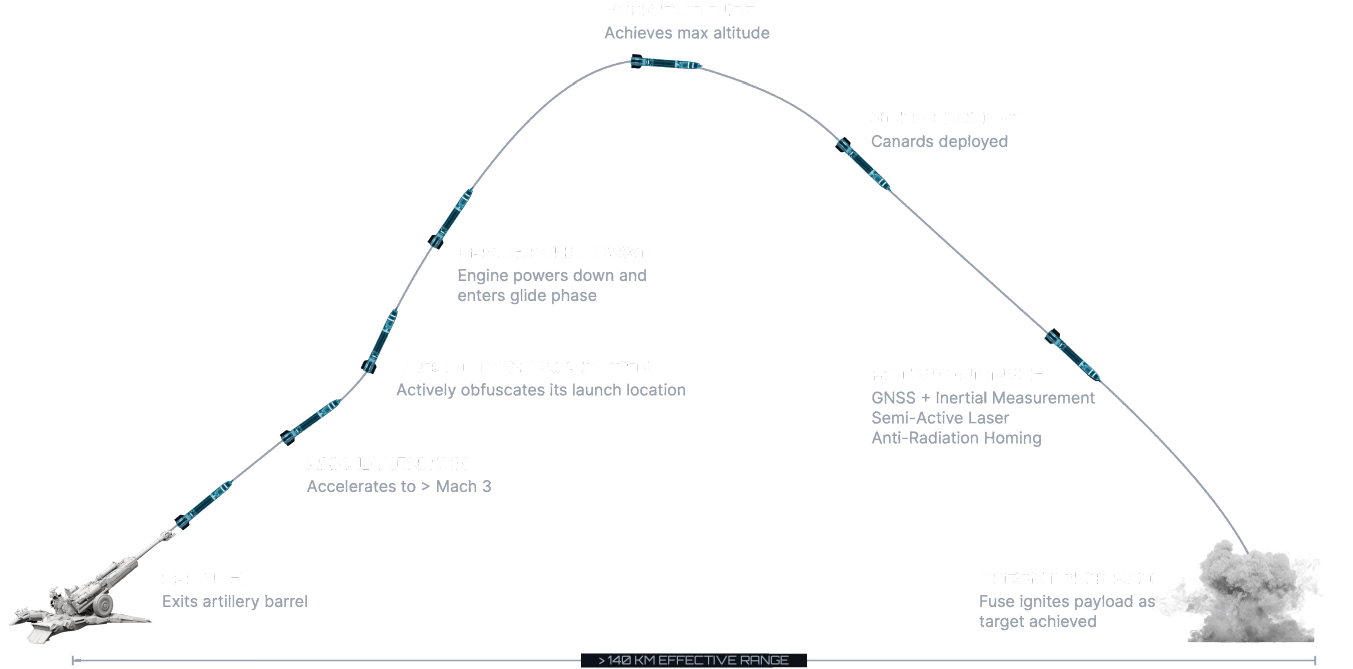
The TRBM 155HG awaits launch detection, with all systems powered at setback upon leaving the barrel.
Upon leaving the barrel, fuel injection and combustion are initiated. There is very short delay before the ramjet is fully operational, with the munition traveling at supersonic speeds, and safely downrange from the point of launch.
The TRBM 155HG cannot acquire GPS signal while in the barrel of the artillery. Following launch, there is a delay in the navigation solution due to the high G shock on the IMU and the acquisition of SVs for GPS correction data. With a fast TTFF, the navigation solution is corrected shortly after launch, and IMU errors estimates converge after sufficient correction updates are received. After all error estimates are at desired confidence levels, a superior strap-down navigation solution can be maintained for a longer period of time, allowing operation in degraded or denied environments if other methods or correction sources are unavailable.
Telemetry data is fed into the flight controller, which takes current speed, acceleration, time since launch, fuel remaining, and atmospheric data to continuously compute a trajectory projection. This projection is compared with the designated target, and the TRBM 155HG flight control surfaces are adjusted accordingly to ensure the proper flight trajectory is maintained.
Once the fuel is exhausted, the ramjet will cease to operate and the projectile will continue on its guided trajectory.
The TRBM 155HG achieves peak altitude and begins a glide decent to the target.
Once the TRBM 155HG reaches its target, the fuze will activate the payload.
TRBM 155HG has been designed to actively guide the munition to a target with a 3.5M CEP within the baseline ballistic zone. If the desired target is outside of that zone due to weather factors or mistargeting of the artillery, then the target can not be reached. To minimize this issue and assist with artillery baseline and atmospheric-compensated targeting, Tiberius is developing an advanced targeting system into the TRBM-CAPP that incorporates real-time atmospheric data into its calculations and an alerting system to confirm artillery alignment before firing.
Tiberius is primarily an aerospace design and intellectual property licensing company that operates independently from the purchasing, manufacturing, and distribution processes. Tiberius supports in-house manufacturing on a cost-plus-margin basis to ensure a competitive supplier ecosystem.
Each client (country) is required to enter into an IP Design and Licensing Services Agreement with Tiberius to have access to specific program technology, suppliers, and support services. This agreement is independent from product manufacturing, delivery, and hardware support.
Initial Fee (includes first year service fee): $5,000,000Subsequent Annual Services Fee: $2,500,000Minimum term: 3 years
Lead time: 6 months
Order quantity limits: 1000 min - 10,000 max
Delivery: Progressive schedule with full delivery no later than 180 days.
Training and support: In-field and online (24x7x365)
Software updates: Included with Tiberius services agreement
Tiberius Manufacturing Pricing: Cost of manufacturing + 25% margin
TRBM 155HG
Unit level pricing (base models) at standard production levels starting at:
(excludes payload, fuel, and fuze module)
@ 1000 UNITS
$52,000 (+/- $2,000)
@ 1 UNITS
$15,000 (+/- $4,000)
@ 1 UNITS
$52,000 (+/- $4,000)
TIBERIUS AEROSPACE
Australia • United Kingdom • United States of America
Specifications and design are subject to change without notice. No reproduction in any form of this brief, in whole or in part may be made without written authorization from TIBERIUS AEROSPACE.Copyright and Patents Pending
Footer_Logo.svg)


